

Minimalist vs. Maximalist Graphic Design: Which Works Better?

If graphic style is also a brand strategy, then, do you need to add more elements to communicate more, or remove elements so the message is clearer? Minimalist vs. maximalist graphic design:

In the universe of graphic designers, there is a phrase that haunts us and terrifies us : when the client says: “Add more design.”
Although it is ambiguous and sounds confusing, many times the instruction behind that chilling phrase is that they want to add more elements, more colors, more graphics, or more details; that is, they actually want a design with a more maximalist style.
But does having more elements make it a better design?
The counterpart to “add more design” is minimalist design. Being an opposite style, it focuses on the reduction of graphic elements and centers only on what is essential to communicate.
In a world where information is unlimited and competition is increasingly extensive, the question arises: What type of design would work better for your brand, minimalist or maximalist?
Table of contents
The Power of the Essential Minimalist Design
Minimalist design is a style that reduces what is not fundamental in order to communicate better. It is based on following a logical, functional structure based on simplicity and order, always seeking to maintain only those elements that are essential.
I can give you an unorthodox example of where you have seen minimalism applied in the best way: Pocoyó (2005).
It sounds like a strange example, but hear me out: Pocoyó is an animated series for children where everything happens on a white background.
You might say, can a white background communicate anything? The short answer is: yes. It communicates imagination: the spaces, the focus on the personalities of its characters, and the narrative of the story being told. Therefore, Pocoyó is a clear example of how a minimalist style communicates everything it needs to, keeping only the essential.
Technically speaking, much of Western minimalist design can be explained starting from the Bauhaus, a school of architecture and design born in 1919 in Weimar, Germany, where its main focus was to unify art with industry in a practical and functional way.
The Bauhaus artists understood that what was created had to fulfill a useful function before being decorative; therefore, only the essential was prioritized, reducing, ordering, and synthesizing designs.
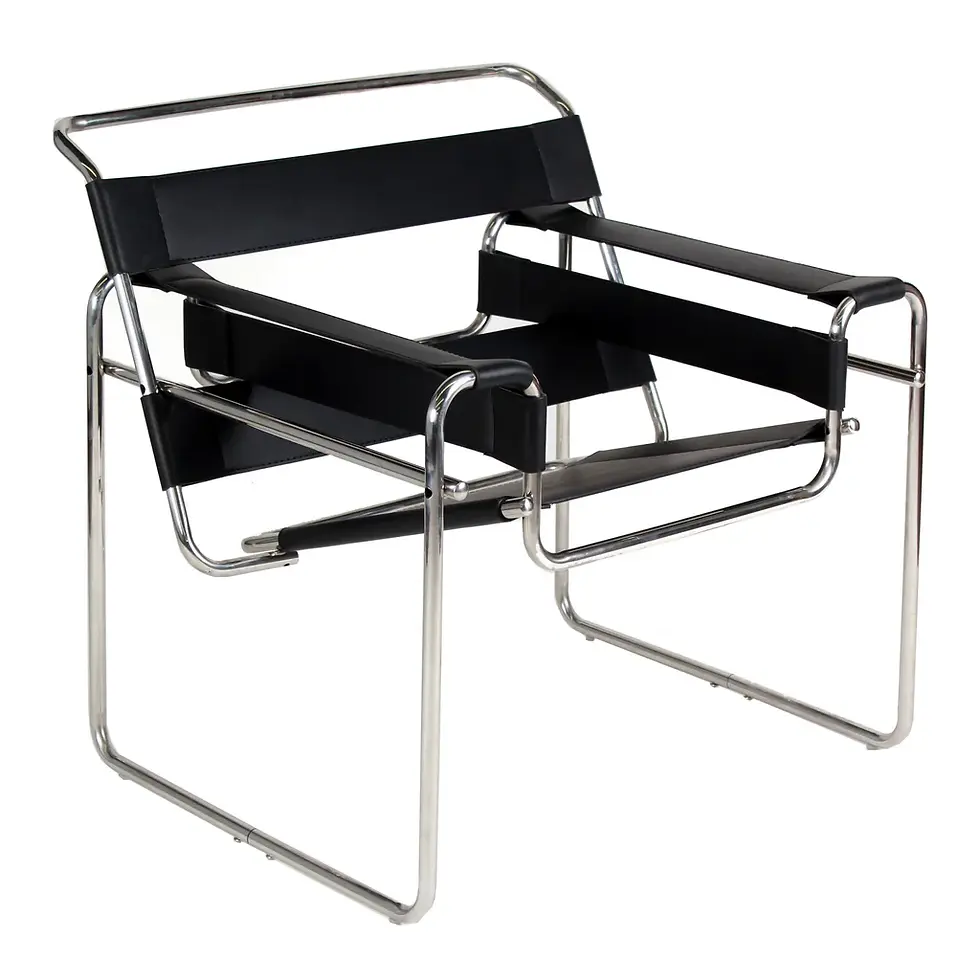
A clear example is the Wassily Chair (1925–1926) by Marcel Breuer. Inspired by a bicycle tube, it uses bent nickel-plated tubular steel and materials like leather or canvas, achieving a structure that is light, resistant, and visually simple. It is a piece that reflects the principles of minimalism very well.
Beyond being just an aesthetic, it is often considered a timeless design, meaning it can remain current for many generations.
Furthermore, in a context where everything is consumed quickly, communicating clearly and directly can represent an advantage. However, it is important to clarify: minimalism is not synonymous with speed, at least not in its creative process.
And it is precisely here that the contrast begins to emerge: if minimalism seeks to reduce, order and synthesize, what happens when the intention is completely opposite?
The Impact of Abundance: Maximalist Design
If minimalist design defended the phrase: “less is more,” subsequent currents began to respond with a completely different vision: “more is more.” This idea does not seek to eliminate elements or maintain only the fundamental, but to add to and intensify the visual experience.
Maximalism favors the mix of shapes and sizes with very few restrictions.

A recognized work that serves as a clear example is The Kiss (1907-1908) by Gustav Klimt.
In its composition, we can observe a great visual variety: different textures in the background, a constant play of patterns, and a contrast between the two characters shown. In the male character, we can see he is covered in dark vertical rectangles, while in the female character, softer shapes predominate, with circles of different sizes and floral elements.
Each detail contributes to the narrative of the work, reflecting both the visual intention and the author's style. Here, the abundance is not meaningless excess, but an essential part of the communication.
This approach is not limited to classical art. A more contemporary example applicable to a personal brand is content creator Berenice Castro, better known as Benulus.

Her style is built from the accumulation of elements in her way of dressing: layers, accessories, garments of different colors and textures, where visual excess continues to function as a resource to express personality.
There are many examples in our daily lives that follow this logic: proposals that embrace excess in every detail as a resource to generate impact, without limitation, but seeking a more intense visual experience
Not Trend, but Intention: What Works Better?
Trying to choose between minimalism and maximalism is not simple, as it is not just an aesthetic matter; it goes further. The choice of these graphic design styles depends heavily on the message we want to convey. Minimalist vs. maximalist graphic design:
Advantages of Minimalist Graphic Design:
Minimalist design offers a variety of advantages that can enhance our project, such as:
Clarity and simplicity: By reducing unnecessary elements, there are no distractions, only elements that serve a purpose.
Timelessness: Because it does not depend on fleeting trends, it stays current over time.
Versatility: It is simpler to adapt to different formats, whether on web pages, social media posts, business cards, etc.
Advantages of Maximalist Graphic Design:
On the other hand, the maximalist style allows for a very memorable experience due to its great freedom of expression; some of its advantages are:
Greater expressiveness: Every detail supports the final message of the work, making each element part of the project's narrative.
Inspires creativity: Not being limited invites experimentation with styles, textures, colors, etc.
Differentiation: Being more loaded allows for greater expression of brand personality, playing more with elements, and generating a connection with the consumer.
Now that we know how each style communicates, the question that interests us all arises: Minimalist vs. maximalist graphic design, which works better? Should you fill your brand with shapes, textures, and colors? Or should you leave it clean, keeping only what is essential?
The correct answer depends on your project’s personality. We often think that just because something is trending, it is what will work for us; however, as I mentioned before, we must look beyond what is "trendy" to try to communicate your brand's messages assertively.
And this is precisely where graphic design ceases to be an aesthetic decision and becomes a strategic one.
When style becomes strategy: Minimalist vs. Maximalist graphic design

Although each style has a very clear visual projection, deciding between minimalist vs. maximalist graphic design becomes a strategy that will dictate your project's personality. Therefore, it cannot rely solely on the personal preferences we have regarding these styles, but rather we must consider the communication objectives that will determine the visual identity.
Minimalist vs. maximalist graphic design, how do you do it? Consider:
Know your audience
Before you begin creating your project's graphic style, you need to know many details about who your consumers are or will be. Here, it is useful to return to the "questioning stage" of a two-year-old and ask yourself a thousand questions, such as: Who is our audience? What are their needs, goals, and preferences? What emotions do we want to generate in them? What actions are we looking to awaken in the consumer? How do they consume us? What do they want from a product/service like ours? Etc. All these questions will be necessary, because the more you know your audience, the more context you will have to choose the type of design that will help you go directly to those you want to reach.
Sector in which you compete
Although you don't want to do the same thing as your competitors, it is important to know the styles in which they project themselves, as each sector has its own visual codes; the way a technology sector expresses itself is not the same as the fashion sector.
Also, consider that if everyone is doing the same thing, how could you stand out? And if you do stand out, will your audience still understand what you are? Find a balance between differentiation and communicating your field.
Brand personality
You have to see brand personality as the personality of a person. A brand must express that personality visually; is your brand fun, elegant, or serious? A brand with an adventurous personality is not the same as one that is much more sober and reserved; there are many nuances of its personality that will tell us how it expresses itself.
Choosing between these two styles, whether maximalism or minimalism, is not just a matter of personal taste, but of the direction you want to give your project. It is about understanding what you need to communicate and, from there, making visual decisions that truly support it.
Designing better, not more (or less)
Throughout the history of design, both minimalism and maximalism have proven to be equally effective. They are tools that communicate certain signals to the consumer (if they are used with mastery and intention). The difference is not how many elements we add or remove from a design, but rather that those elements fulfill a purpose in our communication.
There will always be trends, and it is fine to think about whether we should use them or not, but instead of making it an obligation to use them to follow the "fad," ask yourself: what is most applicable to your brand? The minimalist vs. maximalist graphic design style you choose will speak for itself before anyone gets closer to getting to know it better.
About the author

Claudia Cruz
Digital Media Designer at Werko Marketing Solutions and audiovisual producer with a passion for photography and graphic design. Her experience in image development for social media and advertising allows her to combine creativity with functionality.


